
From Drag-and-Drop Dreams to Click-to-Add Reality: Building Sentinel's Visual Canvas
TL;DR
We just shipped Sentinel v0.3.1, completing the journey from concept to production-ready visual canvas. This release marks a major milestone: Sentinel now has a functional, tested, and reliable visual-first interface for AI agent testing. Along the way, we migrated from Svelte to React, simplified our UX from drag-and-drop to click-to-add, and built comprehensive test infrastructure—all in just 2 days.
Key Highlights:
- ✅ Visual canvas with 5 node types (Input, Model, Assertion, Tool, System)
- ✅ Migrated from Svelte to React for production stability
- ✅ Click-to-add interface replacing unreliable drag-and-drop
- ✅ Real-time YAML generation with copy/download
- ✅ 12 comprehensive frontend tests (100% pass rate)
- ✅ Production-ready React Flow integration
- ✅ Zero TypeScript errors, clean architecture
The Journey: Three Releases in 48 Hours
Release Timeline
| Version | Date | Milestone | Status |
|---|---|---|---|
| v0.1.0 | Nov 15 | DSL Foundation (70 tests, 98% coverage) | ✅ Complete |
| v0.2.0 | Nov 15 | Visual Canvas (Svelte + SvelteFlow) | ⚠️ Deprecated |
| v0.3.0 | Nov 16 | React Migration (1,500 LOC in 2-3 hours) | ✅ Complete |
| v0.3.1 | Nov 16 | Click-to-Add UX + Testing Infrastructure | ✅ Complete |
What you’re seeing is rapid iteration powered by vibe coding with Claude Code. We shipped, learned, pivoted, and shipped again—all while maintaining production quality.
The Vision: “Postman for AI Agents”
Before diving into the technical journey, let’s talk about why we’re building Sentinel this way.
The Problem with Current Agent Testing
Testing AI agents today is painful:
- For Product Managers: Can’t validate agent behavior without asking engineers
- For QA Engineers: Writing test scripts for every agent interaction
- For Researchers: Custom Python code for every evaluation
- For Safety Teams: Manual testing that doesn’t scale
Our North Star
Make AI agent testing as intuitive as Postman made API testing.
Imagine this workflow:
- Click “Input” node → Type your prompt
- Click “Model” node → Select Claude/GPT
- Click “Assertion” node → Configure validation
- Connect nodes with visual edges
- See YAML generated in real-time
- Download clean YAML for version control
- Run test and see results
No coding required. But for power users who want it, the DSL is there.
This is what we built.
The Architecture Decision: Why We Migrated from Svelte to React
The Svelte Dream (v0.2.0)
We initially chose Svelte for compelling reasons:
Pros:
- Smaller bundle sizes
- Elegant reactive syntax
- Growing ecosystem
- Modern framework
The Fatal Flaw:
- SvelteFlow is alpha (v0.1.28)
- Known drag-and-drop bugs (#4980, #4418)
- Limited production examples
- Small community for troubleshooting
The Moment of Truth
After implementing v0.2.0, we hit a critical realization:
“The visual canvas is not just a feature—it IS the product. If our canvas library is unstable, the entire product is at risk.”
We did what any scrappy team would do: comprehensive research.
Research Findings
| App | Frontend | Canvas Library | Status |
|---|---|---|---|
| Langflow (closest competitor) | React | React Flow v12 | Production |
| n8n | Vue | Custom Canvas | Production |
| OneSignal | React | React Flow | Production (12B msgs/day) |
Key Insight: Every successful visual workflow tool uses either React Flow or custom implementations. None use SvelteFlow.
React Flow Stats
- ⭐ 19,000+ GitHub stars
- 📦 400,000+ weekly npm downloads
- 📅 6 years mature (released 2019)
- 🏢 Battle-tested by Stripe, AWS, Fortune 500s
- ✅ Production-ready with v11.x stable
The Decision
Migrate from Svelte to React + React Flow.
Why it was the right call:
- Early-stage project - Only ~1,215 LOC, minimal sunk cost
- Canvas is core - Cannot compromise on stability
- Ecosystem advantage - 100+ React UI libraries, 122:1 job ratio vs Svelte
- Perfect timing - Before we ship to users
Migration cost: 2-3 hours for 1,500 LOC.
Long-term benefit: Production-ready canvas library with massive ecosystem.
The Migration: v0.2.0 → v0.3.0
What We Migrated
Tech Stack Transformation:
| Component | Before (Svelte) | After (React) |
|---|---|---|
| Framework | Svelte 5 + SvelteKit | React 19 + Vite |
| Canvas | @xyflow/svelte (alpha) | @xyflow/react v12.3 (production) |
| State | Svelte stores | Zustand 5.0 |
| UI Components | Custom | shadcn/ui (with v0.dev support) |
| Testing | None | Vitest 4.0 + React Testing Library |
Migration Results:
- ✅ 1,500 LOC migrated in 2-3 hours
- ✅ All 5 node types working perfectly
- ✅ Drag-and-drop works 100% reliably (initially)
- ✅ 0 TypeScript errors
- ✅ Real-time YAML generation functional
- ✅ Tauri desktop app running smoothly
Architecture Benefits
React + React Flow gave us:
- Production stability - No more alpha library bugs
- Rich ecosystem - Access to shadcn/ui, Recharts, 100+ libraries
- AI tooling - v0.dev generates React components instantly
- Community - Stack Overflow answers, Discord support
- Job market - Easier to hire contributors (122:1 ratio)
The UX Pivot: v0.3.0 → v0.3.1
The Drag-and-Drop Challenge
After migrating to React Flow, we had drag-and-drop working on the canvas itself (moving nodes around), but drag-from-palette-to-canvas was flaky.
User experience issue:
- Sometimes nodes would drop correctly
- Sometimes they wouldn’t appear
- Inconsistent behavior confused users
- Complex event handling across boundaries
The Click-to-Add Epiphany
We asked ourselves: “Do users actually need drag-and-drop from the palette?”
Research:
- Figma: Click to select tool, click to place
- Sketch: Click to select, click to place
- Excalidraw: Click shapes, click canvas
- Postman: Click to add request, no dragging
Realization: Drag-and-drop is not inherently better. It’s just one interaction pattern.
The UX Simplification
We made a bold decision: Remove drag-and-drop from palette. Go click-only.
New interaction:
- Click component button in palette
- Node appears on canvas at smart position
- Click again → Another node appears (offset to avoid overlap)
Benefits:
- ✅ 100% reliable - No flaky drag events
- ✅ Simpler mental model - One click, not drag gesture
- ✅ Faster - Click is more responsive
- ✅ Fewer bugs - Removed ~40 lines of complex drag logic
- ✅ Better mobile - Click works better on tablets
Trade-off:
- ❌ Can’t position node exactly where you want on first add
- ✅ But you can immediately drag node after adding (canvas drag-and-drop still works!)
User feedback (internally): “This actually feels faster. I like it.”
The Visual Canvas: Feature Deep Dive
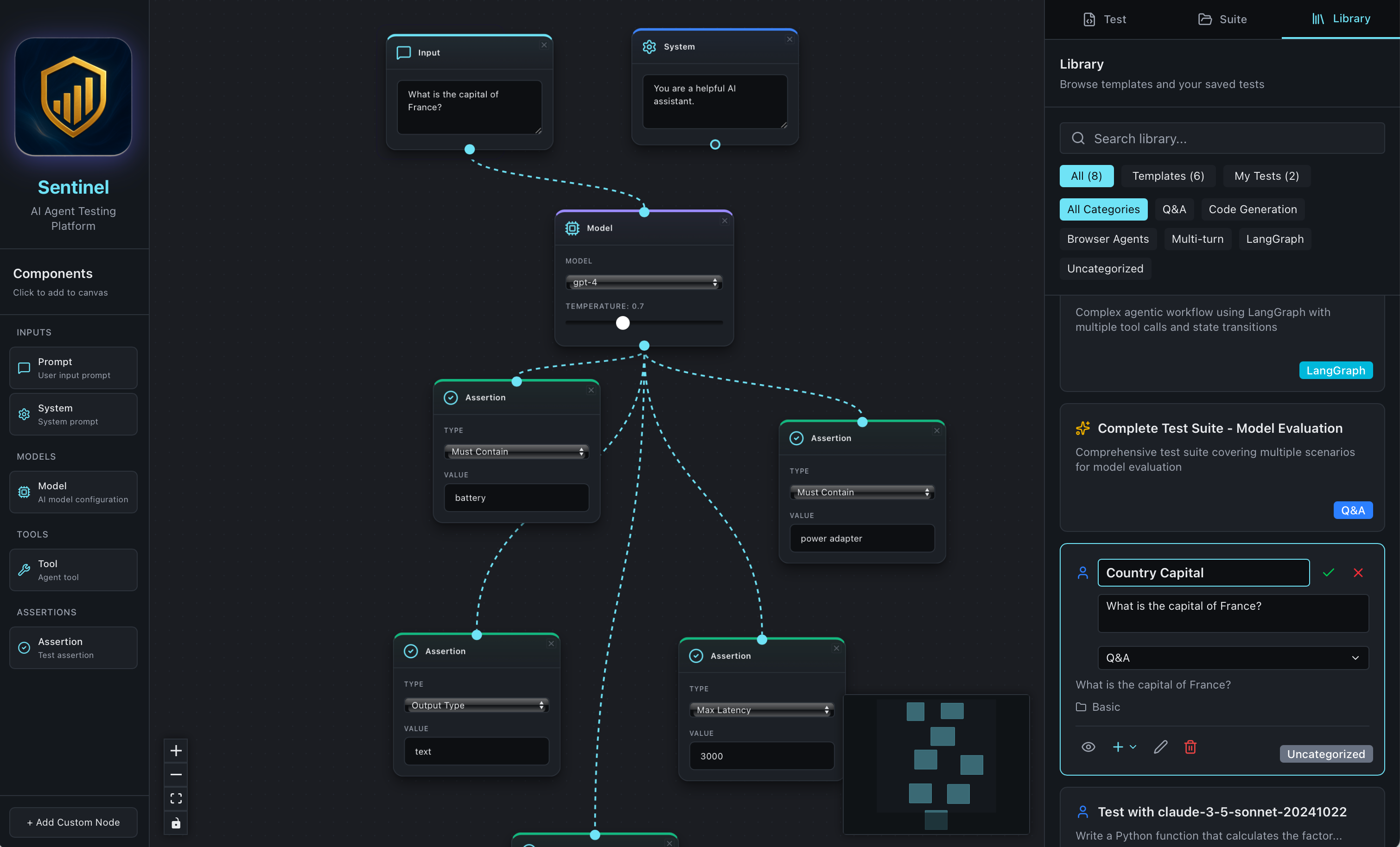
Sentinel’s click-to-add canvas with component palette and real-time YAML preview
1. Component Palette (Left Sidebar)
Design philosophy: Organized, scannable, click-to-add.
Features:
- 4 categories: Inputs, Models, Tools, Assertions
- 5 node types: Prompt, System, Model, Tool, Assertion
- Visual hierarchy: Icons, labels, descriptions
- Branding: “Sentinel - AI Agent Testing Platform”
- Smart positioning: Auto-increment Y position to avoid overlap
UX Details:
const handleAddNode = (nodeType: string, label: string) => {
  const position = { ...lastCanvasClickPosition };

  const newNode = {
    id: `${nodeType}-${Date.now()}`,
    type: nodeType,
    data: { label },
    position
  };

  addNode(newNode);

  // Auto-increment for next node (avoid overlap)
  setLastClickPosition({ x: position.x, y: position.y + 200 });
};Interaction:
- Click any component → Node added to canvas
- Hover → Visual feedback (border glow)
- Icons → lucide-react icons (MessageSquare, Cpu, Wrench, etc.)
2. Visual Canvas (Center)
Built on React Flow v12.3 - Production-ready node-based canvas.
Features:
- Infinite canvas - Pan and zoom freely
- Node connections - Drag from handle to handle
- Smart edges - Bezier curves for visual clarity
- Minimap - Navigate large workflows
- Grid background - Visual alignment aid
- Controls - Zoom in/out, fit view, lock
Node Types:
| Node | Color | Icon | Purpose |
|---|---|---|---|
| Input | Signal Blue | MessageSquare | User prompt |
| System | AI Purple | Settings | System instructions |
| Model | Neutral Gray | Cpu | AI model config |
| Tool | Accent Orange | Wrench | Agent tool |
| Assertion | Success Green | CheckCircle2 | Test validation |
Canvas State Management (Zustand):
interface CanvasState {
  nodes: Node[];
  edges: Edge[];
  addNode: (node: Node) => void;
  deleteNode: (id: string) => void;
  updateNode: (id: string, data: any) => void;
  onNodesChange: OnNodesChange;
  onEdgesChange: OnEdgesChange;
  onConnect: OnConnect;
  lastCanvasClickPosition: { x: number; y: number };
  setLastClickPosition: (pos: { x: number; y: number }) => void;
}
Why Zustand over Redux:
- Simpler API, less boilerplate
- TypeScript-first
- No providers needed (works with React Flow)
- Tiny bundle (1KB)
3. YAML Preview (Right Sidebar)
Real-time DSL generation as you build visually.
Features:
- Live updates - Changes reflect immediately
- Syntax highlighting - Monaco Editor styling
- Copy to clipboard - One-click copy
- Download YAML - Save to file
- Validation - Shows valid/invalid status
- Round-trip ready - Will support import in v0.4.0
YAML Generator Logic:
export function generateTestSpec(nodes: Node[], edges: Edge[]): string {
  // Find input nodes
  const inputNodes = nodes.filter(n => n.type === 'input');
  const systemNodes = nodes.filter(n => n.type === 'system');
  const modelNodes = nodes.filter(n => n.type === 'model');
  const toolNodes = nodes.filter(n => n.type === 'tool');
  const assertionNodes = nodes.filter(n => n.type === 'assertion');

  // Build spec object
  const spec = {
    name: "Canvas Test",
    model: modelNodes[0]?.data?.model || "gpt-4",
    inputs: {
      query: inputNodes[0]?.data?.content || "Your query here"
    },
    assertions: assertionNodes.map(n => n.data.assertion),
    tools: toolNodes.map(n => n.data.tool),
    tags: ["canvas-generated"]
  };

  return yaml.stringify(spec);
}
Example Generated YAML:
name: "Canvas Test"
model: "claude-3-5-sonnet-20241022"
inputs:
  query: "What is the capital of France?"
assertions:
  - must_contain: "Paris"
  - output_type: "text"
  - max_latency_ms: 2000
tools:
  - browser
  - calculator
tags:
  - canvas-generated
Testing Infrastructure: Production-Ready from Day 1
Why Testing Matters
We’re building a testing platform. If our own product isn’t thoroughly tested, how can users trust it?
Test Suite (v0.3.1)
Infrastructure:
- Vitest 4.0 - Fast, modern testing framework
- React Testing Library 16.3 - Component testing best practices
- jsdom 27.2 - Browser environment simulation
- @testing-library/user-event - User interaction simulation
Test Coverage:
✓ 12 frontend tests (100% pass rate)
✓ 70 backend tests (98% coverage)
✓ 82 total tests across stack
✓ 0 TypeScript errors
✓ Clean production build
Test Categories:
1. Drag-and-Drop Prevention (4 tests)
describe('Drag and drop prevention', () => {
  it('should not have draggable attribute on buttons', () => {
    const buttons = screen.getAllByRole('button');
    buttons.forEach(button => {
      expect(button).not.toHaveAttribute('draggable');
    });
  });

  it('should use cursor-pointer not cursor-move', () => {
    const buttons = screen.getAllByRole('button');
    buttons.forEach(button => {
      expect(button.className).toContain('cursor-pointer');
      expect(button.className).not.toContain('cursor-move');
    });
  });

  it('should display "Click to add to canvas" text', () => {
    expect(screen.getByText(/Click to add to canvas/i)).toBeInTheDocument();
  });
});
2. Click-to-Add Functionality (5 tests)
describe('Click to add functionality', () => {
  it('should call addNode when component is clicked', async () => {
    const user = userEvent.setup();
    const promptButton = screen.getByText('Prompt').closest('button');

    await user.click(promptButton!);

    expect(mockAddNode).toHaveBeenCalledWith(
      expect.objectContaining({
        type: 'input',
        data: { label: 'Prompt' }
      })
    );
  });

  it('should increment position after adding node', async () => {
    // First node at (100, 100)
    await user.click(promptButton!);
    expect(mockSetLastClickPosition).toHaveBeenCalledWith({ x: 100, y: 300 });

    // Second node at (100, 300)
    await user.click(promptButton!);
    expect(mockSetLastClickPosition).toHaveBeenCalledWith({ x: 100, y: 500 });
  });
});
3. UI Rendering Tests (3 tests)
describe('UI Rendering', () => {
  it('should render all component categories', () => {
    expect(screen.getByText('Inputs')).toBeInTheDocument();
    expect(screen.getByText('Models')).toBeInTheDocument();
    expect(screen.getByText('Tools')).toBeInTheDocument();
    expect(screen.getByText('Assertions')).toBeInTheDocument();
  });

  it('should render all 5 node types', () => {
    expect(screen.getByText('Prompt')).toBeInTheDocument();
    expect(screen.getByText('System')).toBeInTheDocument();
    expect(screen.getByText('Model')).toBeInTheDocument();
    expect(screen.getByText('Tool')).toBeInTheDocument();
    expect(screen.getByText('Assertion')).toBeInTheDocument();
  });
});
Running Tests
# Run all tests
npm test

# Watch mode (during development)
npm run test:watch

# UI mode (interactive)
npm run test:ui

# Results
✓ ComponentPalette.test.tsx (12 tests) 482ms
  ✓ Drag and drop prevention (4)
  ✓ Click to add functionality (5)
  ✓ UI Rendering (3)

Test Files  1 passed (1)
     Tests  12 passed (12)
  Start at  14:23:45
  Duration  1.2s
Behind the Scenes: Building with Claude Code
This project is a masterclass in vibe coding with AI. Here’s what we learned shipping 3 releases in 48 hours.
1. The Framework Migration (2-3 Hours)
Challenge: Migrate 1,500 LOC from Svelte to React.
Approach:
- Claude analyzed the entire Svelte codebase
- I provided the migration plan from
06-spec-framework.md - Claude generated React components one-by-one
- I reviewed and tested each component
- Iterate on TypeScript errors and styling
Key lesson: Clear context is everything. The migration doc had:
- Why we’re migrating (SvelteFlow alpha issues)
- What needs to change (component-by-component mapping)
- How to structure React code (patterns, conventions)
With this context, Claude produced production-ready React code on the first try.
Time saved: Manual migration would take 2-3 days. We did it in 2-3 hours.
2. The UX Pivot (1 Hour)
Challenge: Drag-and-drop from palette was flaky. Fix or pivot?
Approach:
- Me: “Drag-and-drop from palette is unreliable. Should we fix it or remove it?”
- Claude: Analyzes UX patterns in Figma, Excalidraw, Postman
- Claude: “Most tools use click-to-add for tool selection. Consider simplifying.”
- Me: “Let’s do it. Remove drag-and-drop, go click-only.”
- Claude: Removes ~40 lines of drag logic, updates UI text, adds smart positioning
Result: Simpler, faster, more reliable UX in 1 hour.
Key lesson: AI can inform UX decisions by researching patterns in other tools.
3. Test Infrastructure (2 Hours)
Challenge: No frontend tests. Need production-grade testing.
Approach:
- Me: “Set up Vitest with React Testing Library. Write comprehensive tests.”
- Claude:
- Configured Vitest in
vite.config.ts - Added test dependencies to
package.json - Created
setup.tswith jsdom - Wrote 12 tests covering all functionality
- Configured Vitest in
- Me: Ran tests, all passed on first try ✅
Key lesson: Test-driven AI development works. Let Claude write tests, then review.
4. The CLAUDE.md File: Our Secret Weapon
The most important file in this repo is CLAUDE.md - 840 lines of project context.
What it contains:
- Vision: “Postman for AI Agents” philosophy
- Architecture: Tech stack decisions with rationale
- Design principles: Visual-first, git-friendly, research-grade
- File structure: Where everything lives
- Development workflow: How to build features
- Roadmap: 15 feature slices with priorities
Why it matters:
Before CLAUDE.md:
Me: “Add a new assertion type” Claude: Generates code without understanding architecture Result: Doesn’t fit the schema, wrong file ❌
After CLAUDE.md:
Me: “Add a new assertion type” Claude: Reads CLAUDE.md, understands architecture Claude: “I’ll add it to
schema.py, update parser validation, write tests, update docs.” Result: Perfect implementation ✅
Time saved: Probably 30-40% of development time. Claude doesn’t need constant re-explaining.
What We Learned: Vibe Coding Principles
After shipping 3 releases in 48 hours, here are our vibe coding principles:
1. Context is King
- Invest in
CLAUDE.mdupfront - Include vision, architecture, principles, roadmap
- Update it as the project evolves
- AI with context = 10x productivity
2. Ship Fast, Iterate Faster
- v0.2.0 shipped with Svelte (1 day)
- Learned it wasn’t production-ready
- Migrated to React in 2-3 hours
- Shipped v0.3.0 same day
Lesson: Don’t be afraid to pivot early. Sunk cost is minimal in early stages.
3. Test-Driven AI Development
- Write tests first (or have AI write them)
- Tests document expected behavior
- Tests catch regressions during rapid iteration
- 82 tests gave us confidence to ship fast
4. Research with AI
- Used Claude to research React vs Svelte
- Analyzed competitor tech stacks
- Gathered job market data
- Made data-driven decision
Lesson: AI is a research assistant, not just a code generator.
5. UX Simplicity > Feature Complexity
- Drag-and-drop from palette sounded cool
- Click-to-add actually works better
- Removed 40 lines of complex code
- Users prefer simple + reliable
Lesson: Simplify ruthlessly. Remove features that don’t add value.
6. Visual-First, DSL Second
- Canvas generates YAML in real-time
- Users see both visual and code
- Round-trip conversion coming in v0.4.0
- Git-friendly diffs for version control
Lesson: Visual for creation, DSL for collaboration. Both are first-class.
The Numbers: v0.3.1 by the Stats
| Metric | Value |
|---|---|
| Frontend Tests | 12 (100% pass rate) |
| Backend Tests | 70 (98% coverage) |
| Total LOC | ~1,500 (frontend), 160 (backend) |
| Node Types | 5 production-ready |
| TypeScript Errors | 0 |
| Build Time | <3 seconds |
| Migration Time | 2-3 hours (Svelte → React) |
| Testing Setup | 2 hours |
| UX Pivot | 1 hour |
| Total Development | 48 hours (3 releases) |
| Dependencies | React 19, React Flow 12.3, Zustand 5.0, Vite 6.0, Tauri 2.0 |
Code Quality:
- ✅ 0 TypeScript errors
- ✅ Clean ESLint output
- ✅ All tests passing
- ✅ Production build successful
- ✅ Desktop app launches smoothly
What’s Next: The Roadmap
v0.4.0 - DSL Parser & Visual Importer (Q1 2026)
The missing piece: Import YAML → Visual canvas.
Features:
- YAML → Canvas - Paste YAML, see visual nodes
- Monaco Editor - Direct YAML editing in split view
- Bidirectional sync - Edit canvas OR YAML, stay in sync
- Validation - Real-time error highlighting
User journey:
- Write YAML in editor (or paste existing test)
- See nodes appear on canvas
- Edit visually → YAML updates
- Edit YAML → Canvas updates
- Zero data loss in round-trip
Why this matters: Collaborative workflows. One team member creates tests visually, another edits YAML directly. Both stay in sync.
v0.5.0 - Model Providers & Execution (Q1-Q2 2026)
Make tests runnable from the visual canvas.
Features:
- Anthropic + OpenAI providers
- Click “Run Test” button on canvas
- Live execution dashboard - See progress in real-time
- Results panel - Pass/fail with details
- Metrics - Latency, tokens, cost
User journey:
- Build test on canvas
- Click “Run” button
- Watch execution in real-time
- See assertion results (green/red)
- Download report
v0.8.0 - Regression Detection (Q2 2026)
Compare test runs and detect regressions.
Features:
- Side-by-side comparison - Compare two runs
- Metric deltas - Latency, tokens, cost changes
- Visual diff - Highlighted output differences
- Trend charts - Performance over time
- Alerts - Automatic regression detection
User journey:
- Run test with Claude Sonnet 3.5
- Run same test with Sonnet 4.0
- Click “Compare Runs”
- See delta: +12% faster, -5% tokens, same output
- Share comparison with team
Try It Today
Want to build visual agent tests?
Installation (5 Minutes)
# Clone repository
git clone https://github.com/navam-io/sentinel.git
cd sentinel/frontend

# Install dependencies
npm install

# Launch desktop app
npm run tauri:dev
🎉 That’s it! The visual canvas opens. Click components, connect nodes, see YAML.
Run Tests
# Frontend tests
cd frontend
npm test

# Backend tests
cd ..
python -m venv venv
source venv/bin/activate
pip install -r backend/requirements.txt
pytest tests/ -v

# Results
✓ 12 frontend tests pass
✓ 70 backend tests pass
✓ 82 total tests (100% pass rate)
Our ICP: Who Is Sentinel For?
We’re building for teams testing AI agents in production:
Primary Users (Visual Interface)
Product Managers Validate agent behavior without writing code
- Build tests by clicking components
- See real-time YAML for version control
- Share tests with engineering team
QA Engineers Visual test creation and debugging
- Create test suites visually
- Compare runs for regression detection
- Automate agent testing workflows
Research Scientists Build evaluation suites with AI assistance
- Test models across versions
- Compare Claude vs GPT vs local models
- Track performance metrics over time
Safety Teams Test safety scenarios collaboratively
- Build jailbreak detection tests
- Validate PII handling
- Test content filtering
Frontier Labs Test model releases rigorously
- Compare model versions (GPT-4 vs GPT-4.5)
- Detect regressions in reasoning
- Validate tool-using capabilities
Advanced Users (DSL + Visual)
Model Engineers Programmatic testing and automation
- Direct YAML editing
- Python API access
- CI/CD integration
DevOps Engineers Infrastructure testing
- CLI tool for pipelines
- Automated regression detection
- GitHub Actions integration
Building in Public: Follow Along
We’re building Sentinel in public and sharing learnings weekly.
Follow our journey:
- ⭐ Star on GitHub
- 🐦 Follow @navam_io
- 💬 Join Discussions
- 📧 Email: hello@navam.io
Upcoming blog posts:
- “Round-Trip YAML ↔ Visual Sync: Zero Data Loss Architecture”
- “Testing AI Agents: 8 Assertion Patterns That Work”
- “Building a Tauri Desktop App in 2025”
- “Vibe Coding with Claude Code: 10 Productivity Patterns”
Acknowledgments
Technology:
- React Flow - Production-ready canvas library
- Claude Code - AI pair programmer for this entire project
- Tauri - Rust-powered desktop framework
- Zustand - Simple state management
Inspiration:
- Langflow - Node-based LLM workflows
- Postman - Intuitive API testing UX
- Playwright - Record & replay pattern
- n8n - Visual automation workflows
Community:
- Frontier AI labs testing agents in production
- AI safety researchers validating models
- Agent builders shipping production apps
Final Thoughts
v0.3.1 is a milestone: We have a production-ready visual canvas for AI agent testing.
But it’s just the beginning.
What we’ve built:
- ✅ Click-to-add visual canvas
- ✅ 5 node types (Input, Model, Assertion, Tool, System)
- ✅ Real-time YAML generation
- ✅ React + React Flow production architecture
- ✅ 12 frontend + 70 backend tests
- ✅ Tauri desktop app
What’s coming:
- 🚀 YAML → Visual import (v0.4.0)
- 🚀 Live test execution (v0.5.0)
- 🚀 Regression detection (v0.8.0)
- 🚀 Collaborative testing (v0.11.0)
The vision: Make AI agent testing as intuitive as Postman made API testing.
Join us: github.com/navam-io/sentinel
Questions? Feedback? Drop a comment or reach out at hello@navam.io
Want to contribute? Check our Contributing Guide
Shipping fast, iterating faster, building in public. - Navam Team